Okenite: what it is, where it's from, how to tell it's real
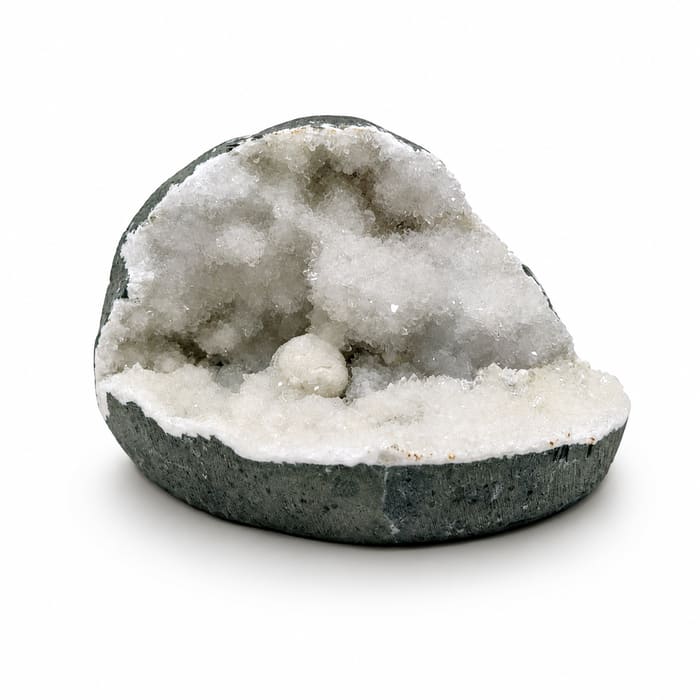
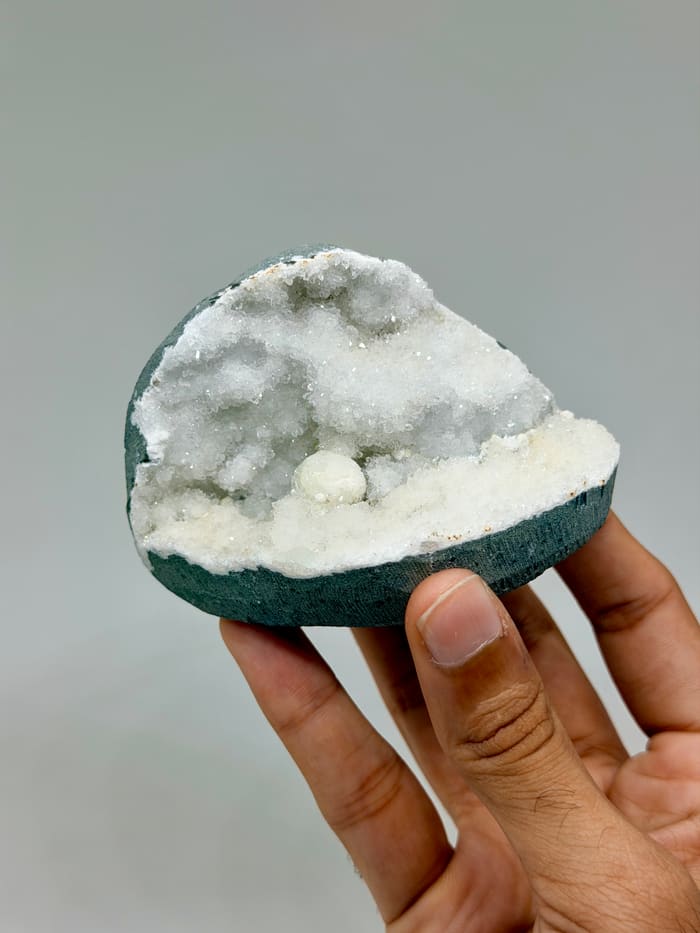
Okenite looks like a snowball or a tuft of cotton wool: a soft white puff of hair-fine fibres, sitting inside a cavity of dark volcanic rock. It's one of the most recognisable minerals from India, and one of the most fragile.
What it is
Okenite is a hydrated calcium silicate. It grows as extremely fine, flexible fibres that radiate from a centre into rounded, fuzzy balls, usually white, sometimes faintly blue or cream. The fibres are so thin that the balls feel soft if touched (they shouldn't be). It forms late in the life of a basalt gas pocket, and is often found with prehnite, apophyllite, stilbite and chalcedony. It's named after Lorenz Oken, a German naturalist.
Where it comes from
Almost all of the okenite on the market comes from the Deccan Traps of Maharashtra, India, the thick stack of ancient lava flows around Mumbai, Pune and Nashik. The basalt is quarried for construction, and when blasting opens a pocket lined with zeolites, quarry workers and local collectors save what they can. Okenite in its own geode, or with sparkling apophyllite, is a classic Indian specimen.
How to tell real okenite
- It really is fibrous. Under a loupe, okenite is a mass of distinct, fine, radiating fibres. It isn't foam, cotton or paint.
- Check it hasn't been handled. Touched or brushed okenite goes flat, matted or grey where fingers have been. A crisp, round, bright white ball has been looked after.
- Mind the name. Other fibrous white zeolites, such as mesolite and scolecite, are sometimes sold as okenite. Mesolite and scolecite form stiffer, straighter needles and sprays, where okenite forms soft, curved tufts.
Looking after it
Okenite is best looked at, not touched. Handle the specimen only by its rock, keep it in a closed cabinet or its box to keep dust off, and don't blow on it hard or brush it. Never wash it: water mats the fibres for good. Kept like that, it stays bright for decades.
See okenite in the shop, and more minerals from the same Indian basalt in apophyllite, prehnite and mesolite.
Questions
- Where does okenite come from?
- Almost all okenite comes from the Deccan Traps basalt of Maharashtra, India, around Mumbai, Pune and Nashik.
- Can I touch okenite?
- Best not. The fibres flatten and discolour where they are touched. Handle the specimen by its rock.
- How do you clean okenite?
- Don't. Keep it in a closed cabinet or box so it doesn't collect dust, and never wash or brush it.